

Schema Markup for Ecommerce: How to Boost Visibility and Clicks
Most importantly, schema markup is necessary in case you want your products to be noticed on Google. Structured data can give your online store a competitive advantage with the rise of AI and mobile-first browsing. In this guide, you’ll learn everything about schema markup for e-commerce, including how it helps, which types to use, and how to implement it correctly. Let’s proceed step by step.
What Is Schema Markup and Why Does It Matter

Schema markup is a coding program that enables search engines to understand your site more effectively. It belongs to a type of data called structured data. Consider them to be the labels for your items on the web page: price, reviews, product name, and product availability, so that they are presented similarly in Google search results.
Schema markup benefits the e-commerce organization by enhancing the way your products are displayed in search results. It assists search engines in distinguishing between what you are selling and what users are searching for. Without it, there are chances of you being buried in the ranks of your competitors even when your product is superior.
Sparktivo assists you in incorporating schema in the correct manner as a brand. We simplify the technical aspect so that you can focus on these.
Benefits of Schema Markup for E-commerce

The schema markup makes a critical difference to the development of your visibility and performance in search results. It promotes your organic click-through rate (CTR) first. Users are more likely to give ratings if the stock status of your listing is displayed, as it provides better indexing and visibility. Google knows your site more quickly and easily, so your products are more likely to be ranked higher. Schema can also be used in voice searches, mobile search discovery, and can be incorporated into Google Shopping features.
Using schema markup for e-commerce can also reduce bounce rates by qualifying clicks. Having checked the price, rating, and description, users click on it if they genuinely have an interest.
Types of Schema Every E-commerce Site Should Use
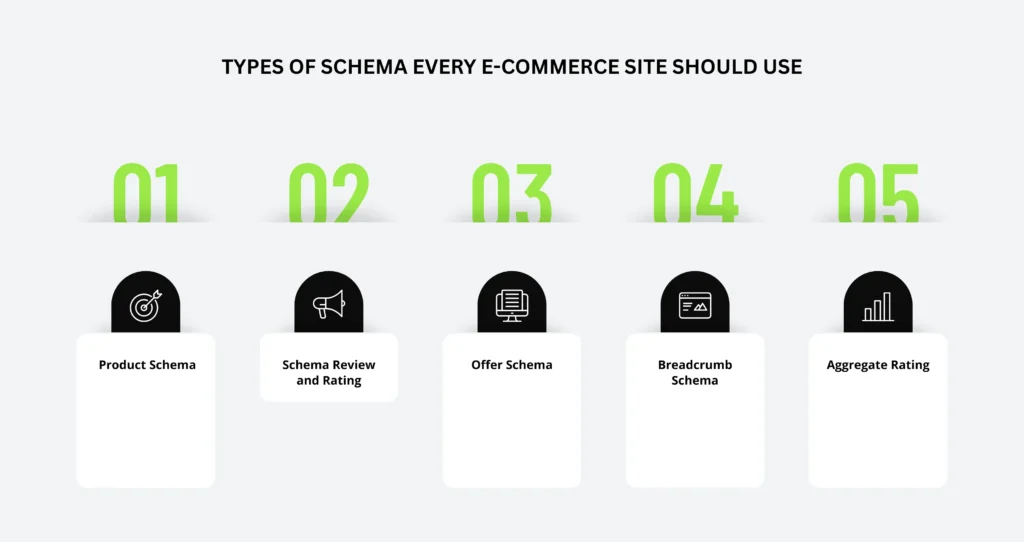
To maximize the benefits, use the following types of schema markup on your e-commerce site:
1. Product Schema
Such a schema contains name, description, brand, price, SKU, and images of your product. It provides Google with the fundamentals, which enable your product to be presented in the best possible way. It should be applied to every product detail page.
2. Schema Review and Rating
Add this markup to display your average rating and review count in the search snippet. It becomes trusting and makes one more involved. Be authentic, never fake! That is what Google is putting to an end.
3. Offer Schema
These points include sales, discounts, shipping charges, or stock levels. Apply it as an element of urgency. It makes your listing more noticeable and increases the conversions.
4. Breadcrumb Schema
There is a breadcrumb navigation. The advantage of adding this schema is that it will enable Google to display your category structure, making it easy for anyone visiting your site to familiarize themselves with it.
5. Aggregate Rating
All user ratings are merged into a single metric within this schema. It assists Google in having a uniform opinion in the search output, thereby enhancing its reputation.
How to Add Schema Markup to Your E-commerce Site

Schema markup may be added in several ways:
- The most frequent one is JSON-LD format. One can easily copy and paste it in the head or body section of the page as a script.
- The majority of the platforms have their own plugins. There are schema-friendly tools that Shopify, WooCommerce, Magento, and BigCommerce offer.
- In Google, the Structured Data Testing Tool is provided to help you test the markup prior to publication.
- Tag Managers or a manual code will suffice when they are developed by backing.
This may sound technical, but there’s no need to worry, as the schema setup is included in the Sparktivo SEO service package.
Schema Markup Best Practices in 2025

Google’s handling of structured data is continually evolving. Here are some updated best practices:
- Use accurate and up-to-date product information in your markup.
- Don’t hide or manipulate the schema. Transparency wins.
- Combine schemas when possible. Product + Offer + Review gives you maximum visibility.
- Check your markup regularly using Google’s Rich Results Test or Schema Validator.
- Stick to JSON-LD format, which is preferred over Microdata.
Schema is robust, but only when it’s implemented correctly.
Common Mistakes to Avoid

Google is never the same in the way it deals with structured information. These are some of the best practices up to date:
- Your markup should contain accurate and up-to-date information about the product.
- The schema should not be suppressed or turned around. Transparency wins.
- Bring together schemas as far as one can. Product + Offer + Review makes you visible to the maximum.
- Regularly update your markup using either the Rich Results Test from Google or the Schema Validator.
- It should adhere entirely to the JSON-LD format (this is preferable to Microdata).
- The schema is strong, but only if it is carried out correctly.
These minor issues can negatively impact your rankings or cause Google to disregard your markup altogether.
About Sparktivo
Sparktivo is one of the organizations that allows e-commerce businesses to develop smarter using automation, analytics, and SEO. It comes as no surprise to us to learn that form is critical in search. That is why we provide a comprehensive schema markup audit, as well as the practical implementation and optimization of rich results. We make structured data easy, whether it’s a new endeavor or an enhancement of what has already been built. We will have your products ready to be placed at the best position in search engines and on devices, and our white-glove schema setup provides that.
Visit sparktivo.com to request your free schema audit and performance review today.
Final Thoughts: Make Schema Your SEO Advantage
Schema markup for e-commerce is a small effort with a massive payoff. It enhances the search appearance of your products, creates credibility, and increases quality clicks to your shop. The demand for structured data is expected to increase in 2025 and beyond. The search engines are developing rapidly. The AI assistants, voice search, and visual search are all included in the schema and provide the results. Ensure that your store does not trail. The rescuer of the hour is Sparktivo.
Want to take your SEO even further? Please read our blog on E‑Commerce SEO Strategies to learn how content, architecture, and linking work together with schema for real growth.